What is Physical AI? How Artificial Intelligence is Moving into the Real World
- Physical AI (Embodied AI) couples machine learning models with physical sensors and mechanical actuators to interact with the real world.
- Three core pillars: Multimodal sensory perception, physics-aware spatial world models, and millisecond-rate closed-loop motor control.
- Sim-to-real training and Vision-Language-Action (VLA) models allow robots to generalize beyond rigid factory scripts while respecting physical safety limits.
For much of the past decade, mainstream artificial intelligence lived inside digital screens—summarizing documents, generating images, and predicting text tokens inside chat windows. Now a fundamental engineering shift is underway: artificial intelligence is stepping into the three-dimensional physical world. This discipline is known as Physical AI, or embodied intelligence.
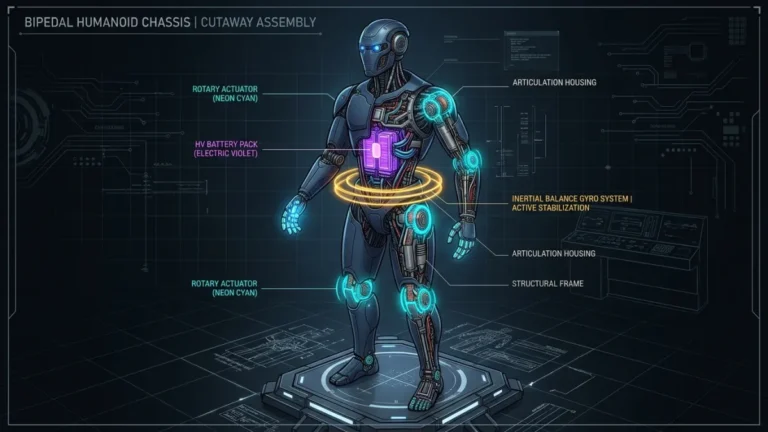
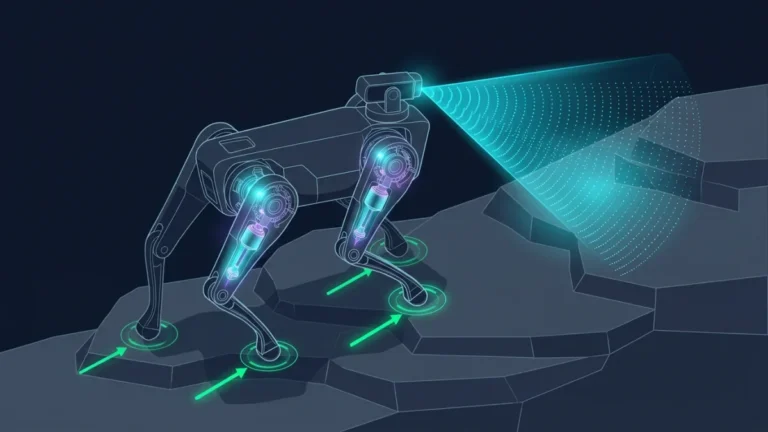
Unlike purely digital software that manipulates pixels and characters in a noiseless environment, Physical AI systems occupy physical bodies. They perceive unpredictable environments through sensors, reason about three-dimensional geometry and contact physics, and apply mechanical forces through wheels, legs, and robotic hands. Understanding how these systems work is essential for anyone following modern robotics and industrial automation.
From Digital Software to Embodied Action
When a large language model outputs an inaccurate word, a human reader simply ignores or edits the text. When an embodied machine miscalculates a trajectory by five centimeters, a robotic arm collides with a workbench or drops a fragile payload. Physical AI must contend with continuous time, sensor noise, mechanical backlash, surface friction, and gravity.
Traditional industrial automation solved this problem by removing uncertainty from the environment. Automotive welding arms operate inside safety cages, repeating identical joint coordinates thousands of times with sub-millimeter precision. If a part arrives slightly rotated on a conveyor, a purely scripted robot fails. Physical AI replaces rigid coordinate replay with adaptive closed-loop perception and control.
The Three Pillars of Physical AI
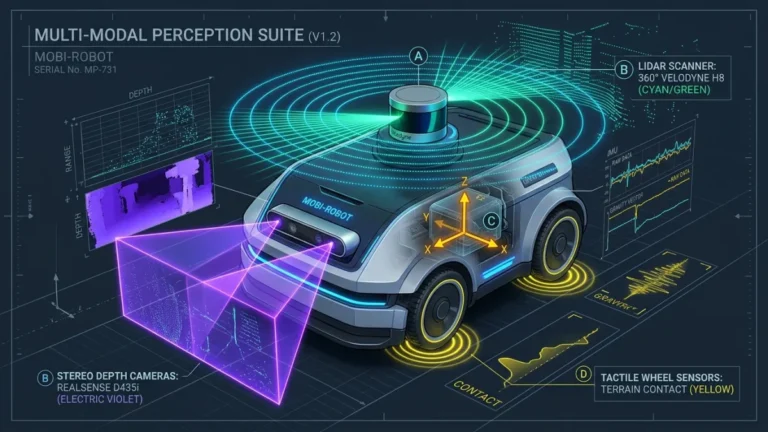
1. Multimodal Perception
Embodied agents fuse stereo depth cameras, LiDAR point clouds, inertial measurement units (IMUs), and tactile pressure arrays to estimate 3D object poses and surface compliance in real time.
2. Spatial World Models
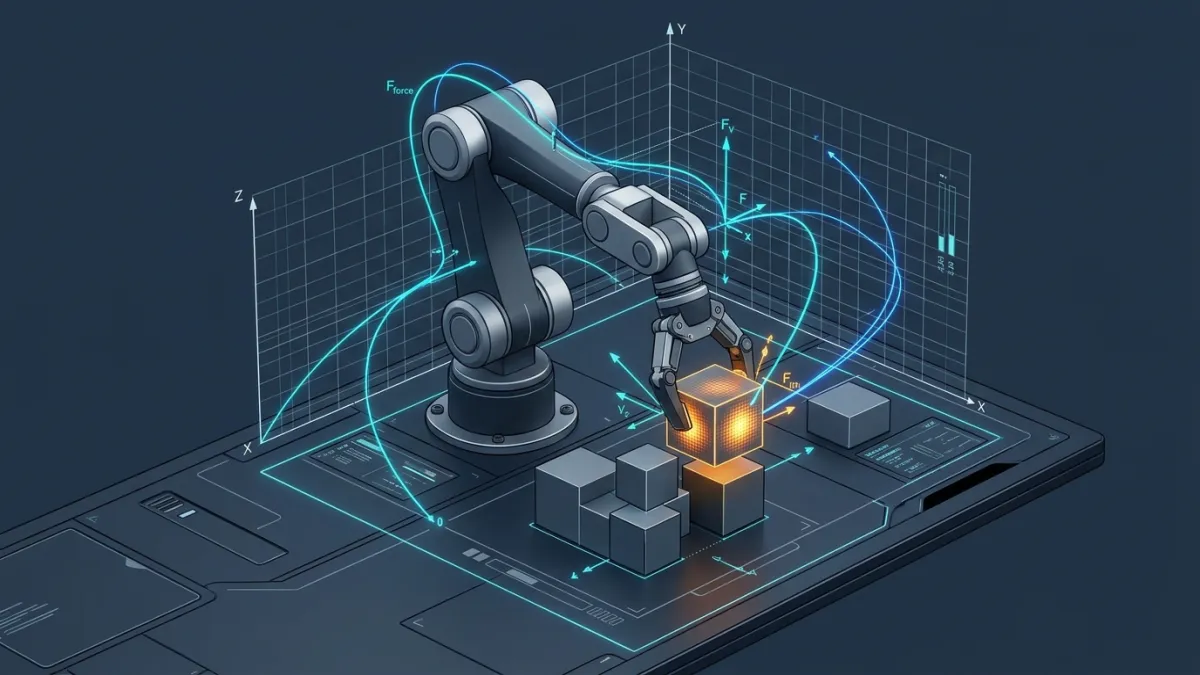
Rather than only predicting text sequences, physical AI architectures model spatial geometry, mass distribution, friction, and occlusion—estimating how objects will move when pushed, grasped, or lifted.
3. Real-Time Actuation
High-level planners issue targets at 10 to 50 Hz, while low-level joint torque and balance controllers execute at 500 to 2,000 Hz so the machine remains stable under external disturbances.
Why Is Physical AI Advancing So Rapidly Today?
For decades, researchers recognized that coupling vision and force control was necessary for general-purpose robots, yet hardware and algorithmic limits kept systems brittle. Three concrete technical breakthroughs have converged to make embodied intelligence viable outside carefully staged laboratory demos:
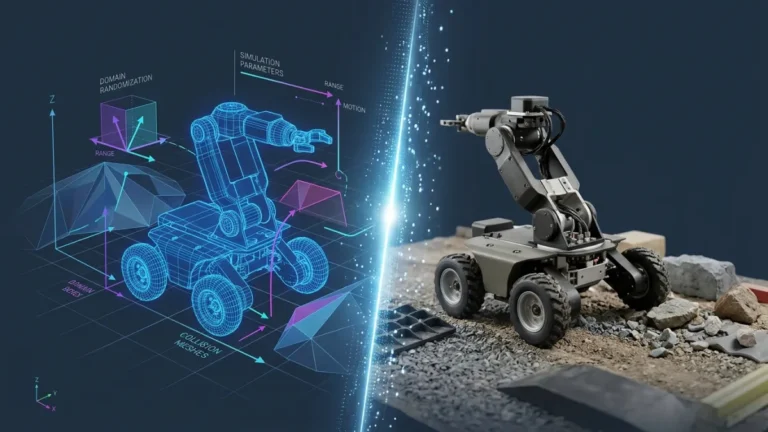
- High-Speed Physics Simulation: GPU-accelerated simulators such as NVIDIA Isaac Sim and the open-source MuJoCo (Multi-Joint dynamics with Contact) physics engine allow engineers to train policies across thousands of parallel virtual robots simultaneously.
- Vision-Language-Action (VLA) Models: As demonstrated in foundational research such as RT-2: Vision-Language-Action Models Transfer Web Knowledge to Robotic Control (arXiv:2307.15818), multimodal transformers can map camera images and natural-language instructions directly into discretized robot action tokens.
- Onboard Edge Compute: High-efficiency neural accelerators and Edge AI microcontrollers execute vision and control models directly on mobile battery power without relying on unstable cloud connections.
Hierarchical Control: How Fast Loops Meet Slow Reasoning
A critical engineering reality of Physical AI is that a multi-billion-parameter vision-language model cannot directly drive motor phase currents at a kilohertz rate. Large foundation models require tens or hundreds of milliseconds per forward pass. If a bipedal robot waited 150 milliseconds to compute ankle torque after stepping on an uneven pebble, it would topple over before the command arrived.
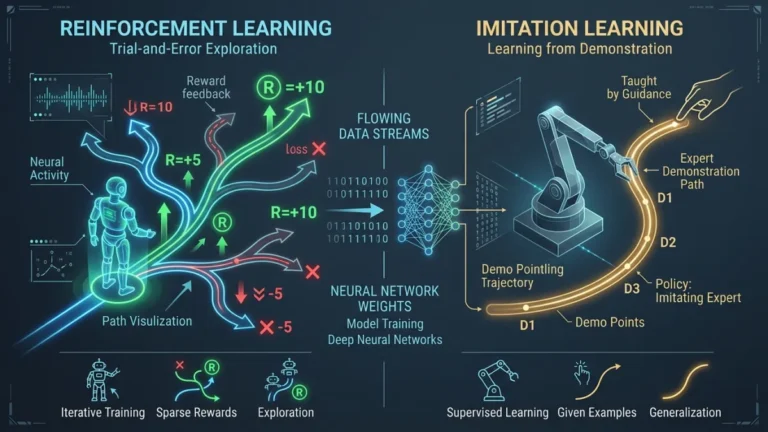
To solve this timing mismatch, modern robotic stacks use a hierarchical architecture. At the top layer, a semantic planner or VLA model runs at 5 to 20 Hz, interpreting camera scenes and breaking a task like “clear the workbench” into sub-goals or trajectory waypoints. In the middle layer, a whole-body policy—often trained via reinforcement learning or imitation learning—runs at 50 to 100 Hz to translate waypoints into desired joint postures. At the bottom layer, deterministic microcontroller loops run at 1,000 Hz or higher to regulate motor torque, joint impedance, and thermal safety limits.
Where Physical AI Is Being Deployed First
Because unstructured physical environments present edge cases ranging from glare and dust to deformable objects, commercial adoption follows a pragmatic gradient from semi-structured industrial spaces toward open-ended environments:
- Logistics and Intralogistics: Autonomous mobile robots (AMRs) and robotic depalletizers identify mixed-size cardboard boxes, estimate center-of-mass shifts, and place parcels onto conveyors without manual barcode teaching.
- Flexible Manufacturing and Inspection: Quadrupeds and wheeled manipulators patrol industrial plants, read analog gauges, detect thermal anomalies, and handle cable routing or compliant part insertion.
- Agricultural and Field Robotics: Vision-guided harvesters and weeding platforms navigate uneven soil and variable sunlight while distinguishing crops from weeds.
Even with modern simulators, transferring learned policies to physical hardware remains challenging due to unmodeled friction and sensor noise—a phenomenon we examine in detail in our guide to the sim-to-real gap.
This official Boston Dynamics video shows how physical robots combine onboard perception with multimodal AI reasoning to inspect industrial facilities:
From my own experience
[ADD MY EXPERIENCE: Describe a real-world robotics demo, simulation environment, or sensor-actuator loop you inspected or tested, and what stood out about its real-time behavior.]
Sources
- RT-2: Vision-Language-Action (VLA) Models Transfer Web Knowledge to Robotic Control (arXiv:2307.15818) — Primary research paper introducing Vision-Language-Action models for embodied robotic manipulation.
- NVIDIA Isaac Sim Official Documentation — Technical overview of photorealistic physics simulation and synthetic data generation for physical AI.
- MuJoCo Physics Engine Documentation (DeepMind) — Official documentation for the Multi-Joint dynamics with Contact physics simulator used in robotics research.
Last updated: November 3, 2026