Humanoid Robots Explained: From Motors to Mind
- Humanoids match human infrastructure: Two legs and two arms allow robots to navigate stairs, narrow aisles, and workbenches built for people—though wheeled bases remain more efficient on flat floors.
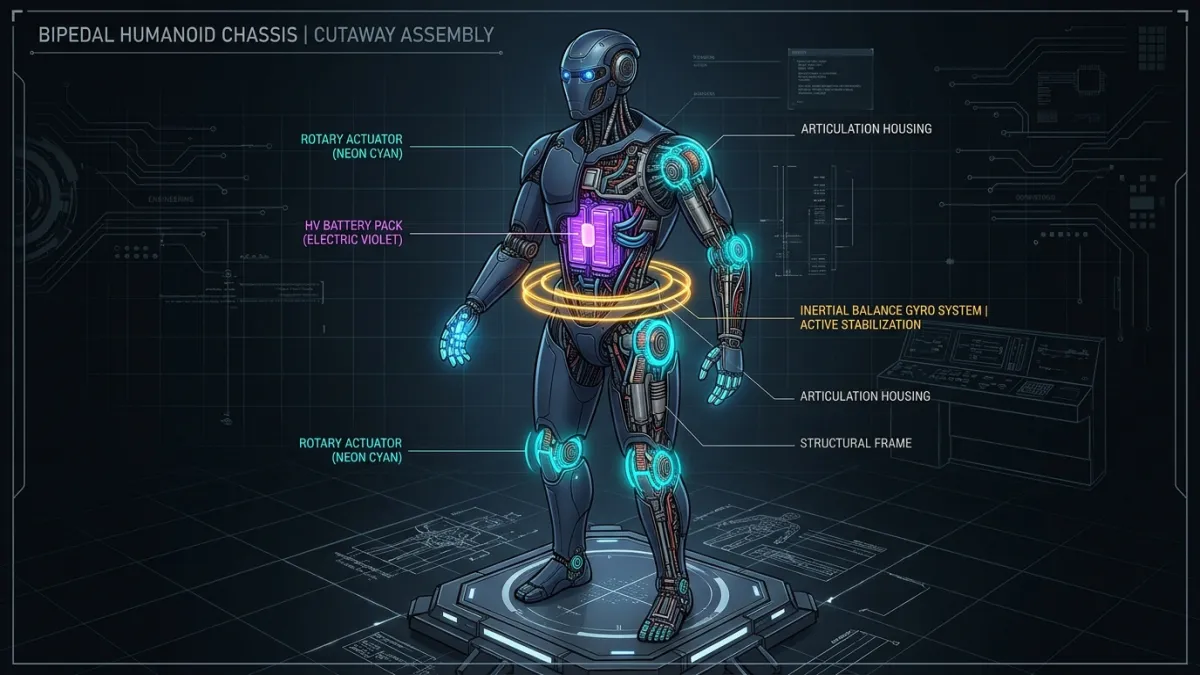
- High-torque electric actuators: Modern platforms largely use frameless brushless DC motors paired with planetary or strain-wave gears for responsive force control.
- Hybrid balance control: Combining Model Predictive Control (MPC) with reinforcement learning enables dynamic recovery from slips and uneven ground.
Over the past few years, bipedal humanoid robots have transitioned from slow research prototypes into agile, electrically actuated machines tested in automotive factories and logistics warehouses. That surge in development raises a practical engineering question: when does a human-shaped robot make sense, and why is it so difficult to build?
In many industrial settings, a specialized wheeled robot or a fixed six-axis manipulator arm is faster, cheaper, and far more energy-efficient than a two-legged machine. However, wheeled platforms struggle when an environment contains stairs, raised door thresholds, scaffolding, ladders, or narrow walkways designed around the footprint of a standing person. Rather than rebuilding factories and commercial buildings to accommodate oversized wheeled bases, engineers design humanoid robots to fit directly into existing human workspaces.
The Mechanical Anatomy of a Modern Humanoid
Early dynamic humanoids—such as the original hydraulic Atlas developed by Boston Dynamics—relied on high-pressure hydraulic fluid pumped through valves to generate massive joint forces. While hydraulic actuation delivered impressive jumping and lifting power, hydraulic systems can be heavy, complex to maintain, and prone to fluid leaks in clean manufacturing environments.
As documented in the official Boston Dynamics Electric Atlas technical overview, modern commercial humanoids have shifted toward compact, high-torque-density electric rotary and linear actuators. Each joint integrates a frameless brushless DC (BLDC) motor, a gear reduction stage, dual absolute position encoders, and a local motor driver on a high-voltage bus (typically 48 V to 100 V).
| Subsystem | Engineering Role | Key Technical Trade-Off |
|---|---|---|
| Quasi-Direct Drive (QDD) Actuators | Low-ratio planetary gears (e.g., 6:1 to 15:1) used in hips and knees for compliant ground impact absorption | High back-drivability and accurate current-based torque sensing, but requires larger motor diameter |
| Strain-Wave (Harmonic) Drives | High-ratio gearing (50:1 to 100:1) used in shoulders, elbows, and wrists for compact lifting | High torque-to-weight ratio and near-zero backlash, but lower back-drivability under sudden impacts |
| Pelvis & Torso IMU Array | High-rate accelerometers and gyroscopes tracking tilt and angular velocity relative to gravity | Requires vibration isolation and sensor fusion with leg kinematics to prevent drift |
| Dexterous Multi-DoF Hands | Tendon-driven or linkage-driven fingers with 6 to 20+ degrees of freedom and tactile pads | Packaging actuators inside a human-sized palm creates severe thermal and tendon-wear limits |
| Torso Battery Module | Lithium-ion pack (typically 1.5 kWh to 2.5 kWh) positioned near the center of mass | Continuous bipedal walking and manipulation typically limit runtime to 2 to 4 hours per charge |
How Bipedal Balance Works: From ZMP to Reinforcement Learning
Standing and walking on two legs is inherently unstable. From a physics perspective, a bipedal robot resembles an inverted pendulum whose center of mass sits roughly one meter above a narrow support polygon formed by the soles of its feet. If the robot’s dynamic center of pressure—often analyzed via the Zero Moment Point (ZMP)—exits that foot polygon without a timely stepping adjustment, gravity pulls the machine to the floor.
Historically, humanoid locomotion relied almost exclusively on analytical control theory and Model Predictive Control (MPC). Engineers formulated simplified mathematical models of the robot’s rigid-body dynamics and solved real-time quadratic programming optimizations at every control tick to compute foot placement and ground reaction forces. While MPC remains exceptionally reliable for predictable motions, hand-tuning analytical controllers for slippery floors, deformable gravel, or unexpected pushes is arduous.
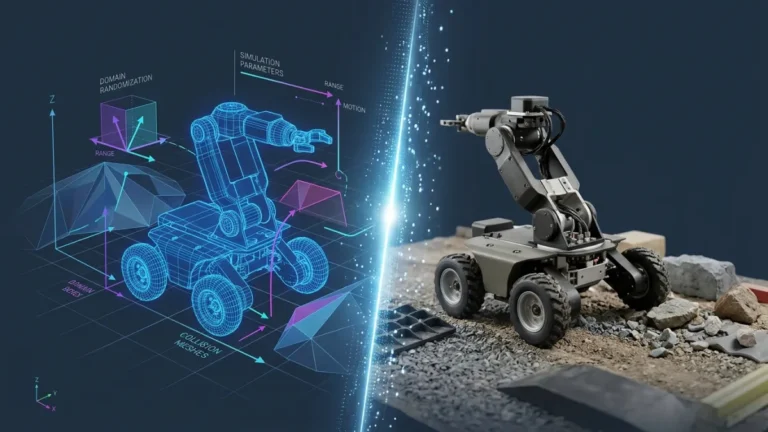
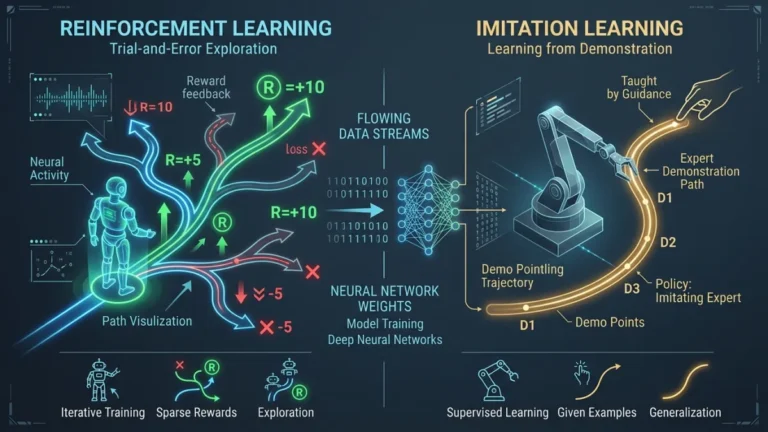
Recent breakthroughs combine model-based control with deep reinforcement learning (RL) and transformer policies. For example, research such as Humanoid Locomotion as Next Token Prediction (arXiv:2401.16889) and sim-to-real bipedal locomotion policies (arXiv:2209.12827) demonstrates how neural networks trained across thousands of randomized simulated terrains learn whole-body balance reflexes. You can read more about how these training paradigms compare in our article on reinforcement learning vs imitation learning.
Unsolved Engineering Bottlenecks
Despite viral demonstration videos, deploying humanoid robots reliably on factory floors requires overcoming three hard physical constraints:
- Specific Energy and Thermal Dissipation: Unlike human skeletal structures that lock mechanically when standing upright, electric motors must draw continuous phase current to hold a bent knee against gravity. That current generates resistive heat ($I^2R$ losses) inside tightly sealed aluminum housings.
- Dexterous Tactile Manipulation: Vision alone is occluded the moment a robotic hand wraps around a tool or cable harness. Reliable assembly requires high-density tactile and force sensors—a topic covered in our guide on the sensors a robot needs.
- Dynamic Fall Safety: A 60 to 80 kg metallic machine operating near human coworkers must guarantee safe torque and velocity limits even if a primary computer or battery contactor fails.
This official Boston Dynamics video demonstrates the fully electric Atlas humanoid rising from the ground and rotating its high-range electric joints:
From my own experience
[ADD MY EXPERIENCE: Describe your observations from evaluating humanoid actuator hardware, walking controllers, or kinematic simulations.]
Sources
- Boston Dynamics Electric Atlas Official Technical Overview — Manufacturer specifications and architecture overview of the fully electric Atlas humanoid platform.
- Humanoid Locomotion as Next Token Prediction (arXiv:2401.16889) — Primary research paper demonstrating autoregressive transformer policies for full-sized humanoid walking.
- Torque-Controlled Bipedal Locomotion via Reinforcement Learning (arXiv:2209.12827) — Research paper on sim-to-real transfer and dynamic balance control for bipedal robots.
Last updated: November 3, 2026